How to Find a High-Quality Meme Coin Entry in 2026 Without Chasing the Pump
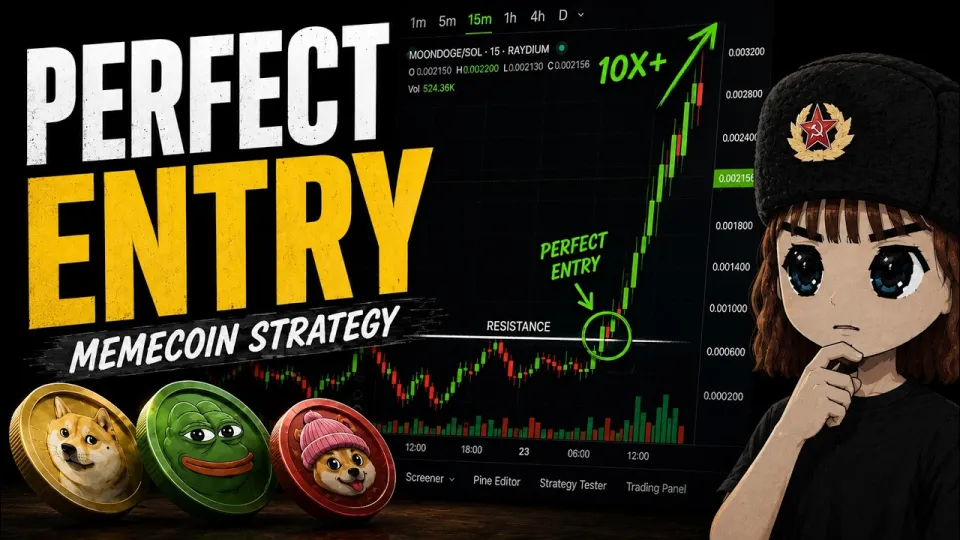
Video: How I Find the PERFECT Entry on Memecoins 📈 (Full Strategy)
You can order the same kind of articles for your own video to boost it on YouTube and Google. Just message the Telegram bot @sat_sit_bot. The bot writes and publishes the articles itself (with your YouTube video embedded) on popular topical websites (no ads). Try it free: 50 articles on us.
Key takeaways
- Most meme coin losses come from timing the entry wrong, not from picking the wrong ticker.
- A valid entry needs structure (higher lows or a reclaimed level), not just a green candle.
- Momentum is confirmed by volume expansion and consolidation, not by the size of the last pump.
- Pullbacks to support and prior breakout zones give better risk-to-reward than buying the vertical move.
- Risk, invalidation level and profit-taking targets should be defined before the buy order.
A high-quality meme coin entry means buying at a predefined level where the chart structure, volume and momentum all agree, with a stop and a profit target set before the order goes in. The coin itself matters less than the price you pay for it: the same token bought on a vertical green candle and bought on a controlled pullback produce completely different risk-to-reward. That is the core idea behind the full entry strategy breakdown published by the starwifpump channel, and the tooling mentioned for paper trading and execution is available through the Plasma Telegram early-access group.
Why the meme coin entry matters more than the pick
Most meme coin traders do not lose because they chose a bad narrative — they lose because they entered at the wrong moment in the move. A token can be genuinely strong and still hand you a 40% drawdown if you buy the third consecutive green candle at the top of an impulse. Conversely, the same token bought on a retest of a broken resistance can carry a stop only a few percent away.
This reframes the whole job. Instead of hunting for the next ticker, the work becomes: wait for a chart to build a structure, define the level where that structure breaks, and only then size a position. Patience is not a personality trait here, it is the actual edge — the market pays you for entering where the invalidation point is close and obvious.
The four conditions of a tradeable setup
A setup is tradeable when four things line up at the same time: structure, momentum, volume and a defined invalidation level. If any one of them is missing, the trade is a guess.
- Structure. The chart should show higher lows, a reclaimed range high, or a clean consolidation box. Random chop with no reference level gives you nowhere to put a stop.
- Momentum. Price should be making progress with expanding volume on up-moves and contracting volume on pullbacks. Momentum is a rate of change, not the size of the last candle.
- Volume confirmation. A breakout on thin volume is usually a liquidity trap. Look for the volume bar on the breakout to exceed the average of the preceding consolidation.
- Invalidation. Before entering, identify the exact price where the idea is wrong — typically below the last higher low or under the reclaimed level. If that price is too far away, the trade is too expensive regardless of how good the story is.
How to read momentum without chasing the pump
Chasing means buying after the move has already paid the people who were early. The way to avoid it is to separate impulse from continuation. An impulse is the first vertical leg — fast, high volume, wide candles. Continuation is what happens after the impulse pauses: price holds a level, volatility compresses, and volume dries up rather than collapsing in price.
Practical filters that help:
- If the candle you are looking at is the largest green candle of the move, you are late, not early.
- If price is more than roughly 20–30% above the nearest structure level, the stop distance makes the trade unattractive.
- If the pullback is deeper than about half of the impulse and volume is rising on the way down, the momentum has probably flipped.
- If the token has already printed several consecutive green hourly candles without a single retest, wait for the first higher low instead of joining the top.
Using pullbacks and support levels to improve entries
Pullbacks are where risk-to-reward is built. A retest of a broken resistance, a revisit of the launch range high, or a touch of a rising moving average all give the same thing: a tight, objective stop. The entry does not need to catch the exact bottom — it needs to be close enough to a level that being wrong costs little.
A repeatable process looks like this: mark the consolidation box the token broke out of, wait for price to come back into the top of that box, require the retest to hold on lower volume than the breakout, and enter with a stop just under the box. Take partial profit into the next impulse rather than holding for an imaginary final target, because meme coin moves rarely give you a second clean exit at the high.
Chart signals that tell you not to enter
Knowing when to stand aside is half of the strategy. The clearest warnings are structural, not emotional.
- Failed breakout. Price pushes above a level, then closes back inside the range on heavy volume. That is distribution, not accumulation.
- Lower highs after a blow-off top. The first lower high after a vertical move usually marks the end of the trend, not a pause.
- Volume divergence. Price makes a new high while volume makes a lower high — the move is being sold into.
- Wide, overlapping candles. Erratic ranges with long wicks on both sides mean liquidity is thin and stops get hunted.
- No reference level. If you cannot draw the line where your idea is invalidated, you do not have a trade.
Planning risk, exits and profit-taking before the buy
The trade plan is written before the order, never after. Three numbers decide everything: entry, invalidation, and the first target. Position size follows from the distance between entry and invalidation — if the stop is 8% away, the size must be small enough that being stopped out is a routine event, not a portfolio-level loss.
A workable template for volatile meme coins:
- Risk a fixed small percentage of the account per trade, and assume the stop will be hit — meme coins gap through levels.
- Take a first partial around 2–3x the risk distance, then move the stop to breakeven on the remainder.
- Scale out into strength rather than waiting for a single exit; liquidity disappears fast when the move reverses.
- Accept that a large share of setups will fail. The process is profitable through the winners that run, not through a high hit rate.
Common beginner questions about meme coin entries
Beginners usually ask the same handful of things: which trackers or filters to use, whether the same approach works on every chain, and how much capital is realistic to start with. The honest answers are unglamorous. Filters on trackers only surface candidates — the entry decision still comes from the chart. The mechanics of structure, momentum and invalidation transfer across chains, but liquidity depth and typical volatility differ, so position sizing has to be adjusted per ecosystem. And starting small is not a limitation, it is how you survive long enough to build a process; a few hundred dollars is enough to practise execution discipline, while a large account and no plan is the fastest way to lose it.
Useful links
- Plasma early access and setup help: https://t.me/+PF-2KHPgQqFiZWJh
- Community Discord: https://discord.com/invite/fr6zzYyBxC
- Trading terminal via Padre: https://trade.padre.gg/rk/star
- Solpump: https://solpump.com/a/STARGOAT
- Author on X: https://x.com/starwifpump
- Live streams on Kick: https://kick.com/startrades
- Axiom terminal early access: https://axiom.trade/@stargoat
- Astrum extension: https://chromewebstore.google.com/detail/plasma-trade/ddealojceghddkopmbfnkajmnadheddn
- Svrog Launcher: https://svroglauncher.com/login?ref=U
- GMGN VIP access: https://gmgn.ai/r/stargoat
- Bloom sniper bot: https://t.me/BloomSolana_bot?start=re
- KCEX registration: https://www.kcex.com/register?inviteC
Final thoughts on building a repeatable entry process
The takeaway is that a meme coin entry is a decision made in advance, not a reaction to a green candle. Structure, momentum, volume and a close invalidation level decide whether a trade exists at all; pullbacks decide whether the risk is worth taking. Anyone can learn this sequence, and the traders who last are the ones who repeat it instead of improvising under FOMO. The full strategy walkthrough comes from the starwifpump channel, and if you want the tooling to paper trade and execute it in one place, join the Plasma Telegram group for early access and setup support.
Questions & answers
What is the best moment to enter a meme coin?
The best moment is a retest of a level the chart has already proven important — a broken resistance, the top of a consolidation box, or the last higher low. At that point the invalidation is close and objective, so being wrong costs little. Buying the vertical green candle gives the opposite: a wide stop and a bad risk-to-reward.
How do I know a pump is real and not a trap?
Real momentum shows expanding volume on up-moves and contracting volume on pullbacks, with price holding structure. A trap usually looks like a breakout that closes back inside the range on heavy volume, or a new price high printed on lower volume. If the breakout candle is the biggest of the move and volume is fading, treat it as distribution.
Does this entry approach work on chains other than Solana?
The mechanics — structure, momentum, volume and invalidation — apply to any chain, because they describe how order flow behaves. What changes is liquidity depth and typical volatility, so position size and stop distance must be adjusted per ecosystem. Thin markets punish oversized positions regardless of how good the setup looks.
How much money do I need to start trading meme coins?
A few hundred dollars is enough to practise execution discipline and record results, which is the real purpose of the first account. The size of the account does not fix a missing plan; it only makes mistakes more expensive. Start small, define risk per trade, and scale only after the process is consistent.
Source: How I Find the PERFECT Entry on Memecoins 📈 (Full Strategy) · Markdown version